Legacy Sensor Integration | CBRN reconnaissance
- Customer
Bundeswehr
- Partner
Systematic | tms
- Environment
CBRN defense
- LAbel
LSI
- Year
2026
The Challenge:
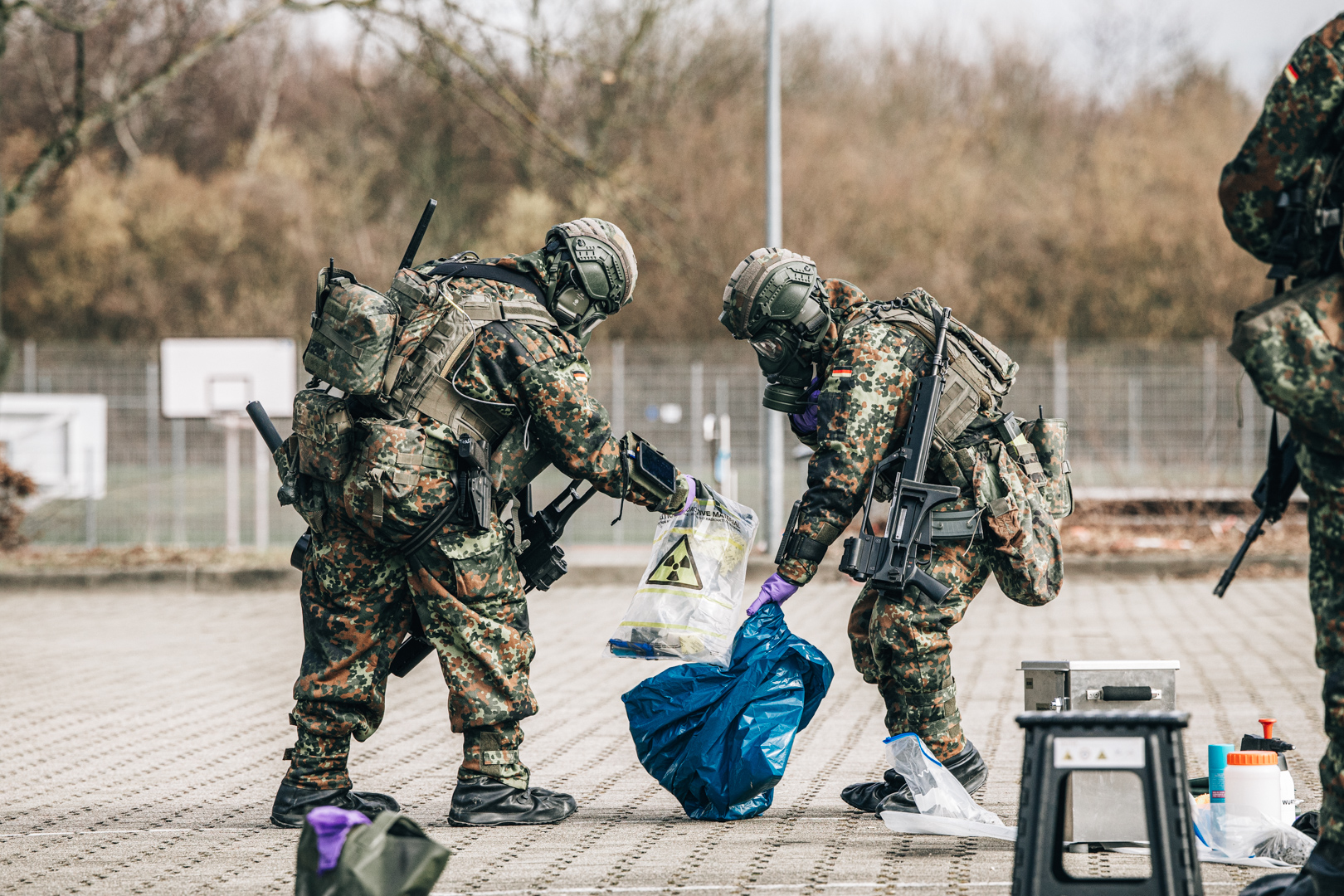
CBRN reconnaissance still relies heavily on fragmented, isolated sensors and manual reporting chains. The German Armed Forces have already fielded a wide range of proven radiological and chemical sensors across the force, but many of these sensors are not connected to digital reporting structures.
As a result, measurements must be read from the device by hand, manually converted into reports, and transmitted by voice or on paper. This process can take hours. During that time, soldiers may remain exposed to hazardous substances or an active combat environment, while the risk of transcription errors and conversion mistakes increases. At the same time, situational awareness is delayed across echelons — from the individual soldier and squad leader to higher-level commands.
The capability already exists in the field — but it remains analog, fragmented, and disconnected.
The Approach:
Project Q creates a continuous digital sensor-to-decider chain without replacing fielded sensors. Legacy sensors are electrically connected through Sensor Connectivity Devices, which act as gateways between the sensors and Hydris.
Hydris integrates and processes the sensor data, provides real-time situational awareness at soldier and squad leader level, transforms mission-relevant detections into NATO-standardized CBRN messages, and orchestrates their exchange into existing CBRN analysis and battle management systems.
The Setup:
Sensor Connectivity Device: Integrates fielded sensors electrically and provides the gateway to man-worn smartphones and the central Hydris compute instance.
Hydris deployed at the edge: The Hydris instance on an Android smartphone displays measurements instantly and creates NATO-standardized CBRN reports.
Hydris integrates with BMS: The Hydris instance on a Windows laptop interfaces with fielded CBRN and Battle Management System (BMS) applications.
The Outcome:
Digitizing the reporting chain reduced the time from measurement to report from hours to minutes. Soldiers no longer have to remain exposed to hazardous substances or an active combat environment for extended periods while reports are processed manually. Human errors and conversion faults dropped to zero, and the Android app enables direct plausibility checks of measurements in the field.
- Q-Box
Running Hydris v0.9 — sensor fusion and rule execution at the edge.
- Q-Seismic × 8
Ground vibration sensors covering the perimeter boundary.
Accelerating and improving processes doesn't require buying everything new. Pragmatic technical products combined with a clear understanding of CONOPS deliver rapidly deployable operational results at low cost. This approach is not limited to CBRN reconnaissance. It can be scaled across a wide range of use cases wherever isolated and disconnected sensors are already deployed in the field.
- Legacy sensor integration — Digitize and enhance the value of the installed sensor base
- Multi-platform deployment — Hydris on the dismounted operator's EUD and the command laptop
- One networked picture — every node is a peer, not a terminal to a central server
Other missions served.

- Detect-to-Engage
- 2026
Counter-UAS | Monitoring Lower Airspace
Lorem ipsum dolor sit amet, consectetur adipiscing elit. Suspendisse varius enim in eros elementum tristique. Duis cursus, mi quis viverra ornare, eros dolor interdum nulla, ut commodo diam libero vitae erat. Aenean faucibus nibh et justo cursus id rutrum lorem imperdiet. Nunc ut sem vitae risus tristique posuere.
Heading 1
Heading 2
Heading 3
Heading 4
Heading 5
Heading 6
Lorem ipsum dolor sit amet, consectetur adipiscing elit, sed do eiusmod tempor incididunt ut labore et dolore magna aliqua. Ut enim ad minim veniam, quis nostrud exercitation ullamco laboris nisi ut aliquip ex ea commodo consequat. Duis aute irure dolor in reprehenderit in voluptate velit esse cillum dolore eu fugiat nulla pariatur.
Block quote
Ordered list
- Item 1
- Item 2
- Item 3
Unordered list
- Item A
- Item B
- Item C
Bold text
Emphasis
Superscript
Subscript
- Track-to-Avoid
- 2026
Maritime Domain Awareness | Collision avoidance
Lorem ipsum dolor sit amet, consectetur adipiscing elit. Suspendisse varius enim in eros elementum tristique. Duis cursus, mi quis viverra ornare, eros dolor interdum nulla, ut commodo diam libero vitae erat. Aenean faucibus nibh et justo cursus id rutrum lorem imperdiet. Nunc ut sem vitae risus tristique posuere.
Heading 1
Heading 2
Heading 3
Heading 4
Heading 5
Heading 6
Lorem ipsum dolor sit amet, consectetur adipiscing elit, sed do eiusmod tempor incididunt ut labore et dolore magna aliqua. Ut enim ad minim veniam, quis nostrud exercitation ullamco laboris nisi ut aliquip ex ea commodo consequat. Duis aute irure dolor in reprehenderit in voluptate velit esse cillum dolore eu fugiat nulla pariatur.
Block quote
Ordered list
- Item 1
- Item 2
- Item 3
Unordered list
- Item A
- Item B
- Item C
Bold text
Emphasis
Superscript
Subscript